
Protests Erupt in Los Angeles Over Immigration Raids
In early June, Los Angeles became a hotbed of unrest as thousands gathered to protest against recent immigration raids. While many demonstrations remained peaceful, tensions boiled over in various areas, particularly in Downtown L.A., where conflicts broke out between officers and demonstrators.
Clashing Interests: The Role of Law Enforcement
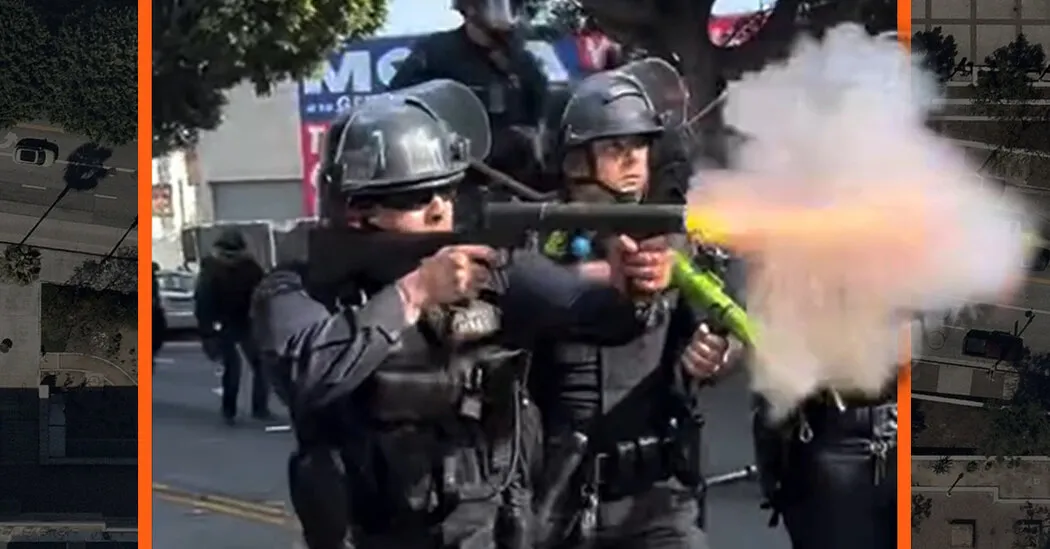
Local law enforcement, faced with escalating confrontations, resorted to using 40-millimeter sponge rounds and foam batons. Although these weapons are touted as methods designed to minimize serious injury or fatality, the reality was starkly different. A comprehensive analysis conducted by The Times revealed a troubling pattern: numerous protesters, including Atlachinolli Tezcacoatl and Kelsey McMurtry, sustained severe injuries from these “less-than-lethal” munitions.
Incidents of Violence
On June 8, around 5 p.m., the atmosphere at East Temple and North Alameda Streets became increasingly fraught. As officers ordered protesters to disperse, tensions escalated. Tezcacoatl, situated at the front of the protest, began filming the proceedings. Amidst the chaos, he was struck by multiple rounds fired by Officer Michael Orozco—one to the chest and another directly to the face.
Footage taken by Tezcacoatl himself corroborated the claim that he posed no imminent physical threat to the officers at that moment. Forensic analysis confirmed that Orozco fired from approximately 46 feet away, suggesting a calculated aim rather than errant fire.
A Pattern of Abuse
Just moments later, another individual, Kelsey McMurtry, found herself in the line of fire as officers attempted to disperse the crowd a block away. Despite retreating and offering no resistance, McMurtry was hit in the head and torso by multiple rounds, sustaining serious injuries, including a traumatic brain bleed. Even after being wounded, she was trampled by a police horse, further compounding her injuries in a chaotic scene.
Officer Protocols and Accountability
The protocols surrounding the use of 40-millimeter rounds are highly specific. As per department guidelines, these munitions should only be directed at individuals posing an immediate threat and should never be aimed at the head unless lethal force is sanctioned. A review by civil rights attorneys highlighted that the actions of officers in these protests appeared to disregard these regulations, constituting excessive use of force.
Department Response and Training
In light of previous controversies surrounding law enforcement brutality—most notably during the George Floyd protests—the L.A.P.D. has faced increased scrutiny. Deputy Chief Michael Rimkunas has publicly defended officers’ actions, suggesting that the rounds are not intended for crowd dispersal. He emphasized that officers typically utilize these munitions against individuals actively posing a threat by throwing objects.
Despite the Deficiencies, the department asserts that they have significantly revamped training procedures related to less-than-lethal weapons, having trained around 5,000 officers in the past three years.
Perspectives from the Ground
Witness accounts capture the chaotic nature of the protests. The police radio chatter reflected their perception of the situation while simultaneously illustrating the intensity faced by officers. Spokesperson for the L.A.P.D. Police Union, Tom Saggau, maintained that the officers demonstrated remarkable restraint in preventing the protests from spreading into other neighborhoods.
Consequences for Protesters
For both Tezcacoatl and McMurtry, the impact of the violence was immediate and severe. Tezcacoatl required surgery for a life-altering injury that will keep his jaw wired shut for weeks. McMurtry, likewise, bears the burden of a traumatic brain injury and other serious ailments resulting from the clashes.
Experts in crowd control weaponry have assessed that the injuries sustained by McMurtry align with those typically seen from police projectiles meant for crowd control.
The Bigger Picture
Upon reviewing the incidents from June 8, the L.A.P.D. reported 52 injuries among its officers, while details regarding the injuries to protesters remain largely anecdotal—illustrating a concerning imbalance in the law enforcement response. The department noted that it has received 59 complaints centered around the use of force during the protests, indicating a broader crisis of accountability.
As the protests over immigration raids in Los Angeles continue to unfold, the tension between crowd control and the rights of demonstrators takes center stage. The fundamental question remains: how can law enforcement effectively maintain order without infringing upon the rights and safety of those exercising their freedom to protest?