

The Los Angeles Firestorm of January 2025: A Tale of Two Communities
A Double Disaster
In January 2025, the Southern California landscape was engulfed by a catastrophic firestorm, primarily affecting the affluent neighborhoods of Pacific Palisades and the historically Black community of Altadena. This so-called double disaster would go on to reshape conversations around emergency preparedness and the disparity in resource allocation during times of crisis. Thousands of homes were scorched, and the fires tragically claimed dozens of lives, leaving a lasting scar on both communities.
Disproportionate Attention
National media attention has disproportionately spotlighted Pacific Palisades, often sidelining Altadena’s struggles. Despite both areas suffering significant losses, residents of Altadena feel their plight has been overshadowed. The spotlight on celebrity victims and influential voices has driven conversations, but they have often neglected the systemic failures evident in Altadena.
Earl Ofari Hutchinson, president of the Los Angeles Urban Policy Roundtable, noted the profound imbalance in the narrative surrounding the fires. “If you just dropped in from another planet, you would think the only area that was hit was Pacific Palisades,” he remarked, highlighting the community’s feeling of being lost in the shuffle.
A Disturbing Evacuation System
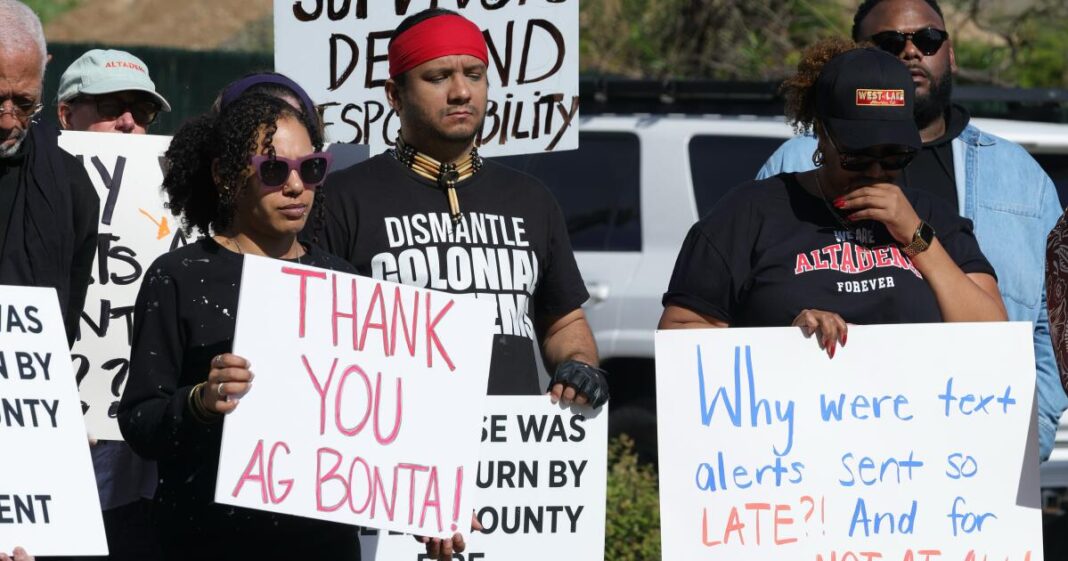
In Altadena, the evacuation alerts arrived too late—after the fire had begun its devastating advance into neighborhoods. Investigations revealed that more affluent areas had received timely warnings, leaving many in west Altadena unprepared and vulnerable. Tragically, the majority of the 19 fatalities linked to the Eaton fire occurred in a mere two square miles of west Altadena, an area that experienced some of the most extensive damage.
The Los Angeles County Fire Department faced scrutiny for its response, and the Los Angeles County Board of Supervisors, which governs Altadena, has been criticized for its oversight of emergency management. The community’s representatives have not only been grappling with emotional pain but also demanding accountability for what many view as an inequitable emergency response.
Calls for Accountability
As frustration grew, Altadena residents mobilized for justice. A group named Altadena for Accountability emerged, advocating for recognition and redress for their community’s grievances. Activist Shimica Gaskins, an Eaton fire survivor, emphasized the long-term struggle for marginalized communities to have their issues recognized. Their continued efforts resulted in the announcement of a civil rights investigation by California Attorney General Rob Bonta. This announcement represents a significant shift toward holding authorities accountable for their failures during the fire.
The Political Landscape
Meanwhile, the political fallout from the Pacific Palisades fire has had notable implications at the municipal level. Celebrity residents have emerged as advocates for change, using their platforms to amplify discontent with L.A. City Hall’s handling of the crisis. The investigation into the Pacific Palisades fire has led to significant political consequences, including the dismissal of the Los Angeles Fire Chief.
In contrast, the atmosphere in Altadena has been more methodical and less sensational. Activists there have focused on systemic change rather than punishing individual actors, advocating for a cohesive approach. Having survived the Eaton fire, many residents express a desire for sustainable solutions instead of immediate retribution.
Systemic Inequities in Focus
Given that Altadena is an unincorporated area, it faces unique challenges in holding accountability across a more dispersed county governance structure. Activists have continually pushed for reform, focusing on systemic issues in emergency management and public safety rather than a “knee-jerk blame game.”
As frustrations mounted, community leaders called for a robust investigation into the failures that led to delayed evacuation alerts and inadequate firefighting resources—specifically targeting the disparities faced by west Altadena. Their efforts have now led to a formal review, although community members remain skeptical about the lack of accountability at the top levels of government.
Pursuing Justice Beyond Fires
In the aftermath of the fires, residents have also focused on long-term recovery and justice, including fair insurance compensation and admissions of liability from Southern California Edison, whose equipment was implicated in sparking the Eaton fire. Activist Shawna Dawson Beer noted that while attention may have initially been diverted to Pacific Palisades, Altadena’s stories and challenges are equally deserving of recognition and resolution.
Activists assert that while competition for attention between two communities is neither constructive nor necessary, it is crucial that both experiences serve as part of a larger narrative addressing emergency preparedness across L.A. County.
Community Resilience
Despite adversity, the spirit of the Altadena community remains strong. With deep-rooted historical significance as a formerly thriving Black enclave, residents are drawing upon their rich heritage to fight for a better future. They’re not merely seeking retribution; they aspire for an equitable dialogue that addresses the core issues of governance, access to resources, and the systemic inequities that have persisted for decades.
As discussions around incorporation and local governance resurface, the community contemplates whether autonomy might allow for more effective resource management and equitable emergency responses in the future. Each breakthrough and setback becomes a part of a larger story, poised for transformation in the wake of tragedy.
Looking Ahead
The ongoing push for justice, recognition, and accountability in Altadena serves not only as a demand for local reform but also as a broader call for awareness surrounding the experiences of marginalized communities in crises. With continued advocacy, residents hope that their struggle will lead to meaningful changes, serving as a blueprint not only for themselves but for other historically overlooked communities across the nation.