

Unpacking the Tensions at L.A. City Hall
Good morning! Welcome to your weekly edition of L.A. on the Record. This week, we dive into a noteworthy incident involving City Council President Marqueece Harris-Dawson and the rippling implications it may have on city governance, policing practices, and racial dynamics in Los Angeles.
A Disturbing Encounter
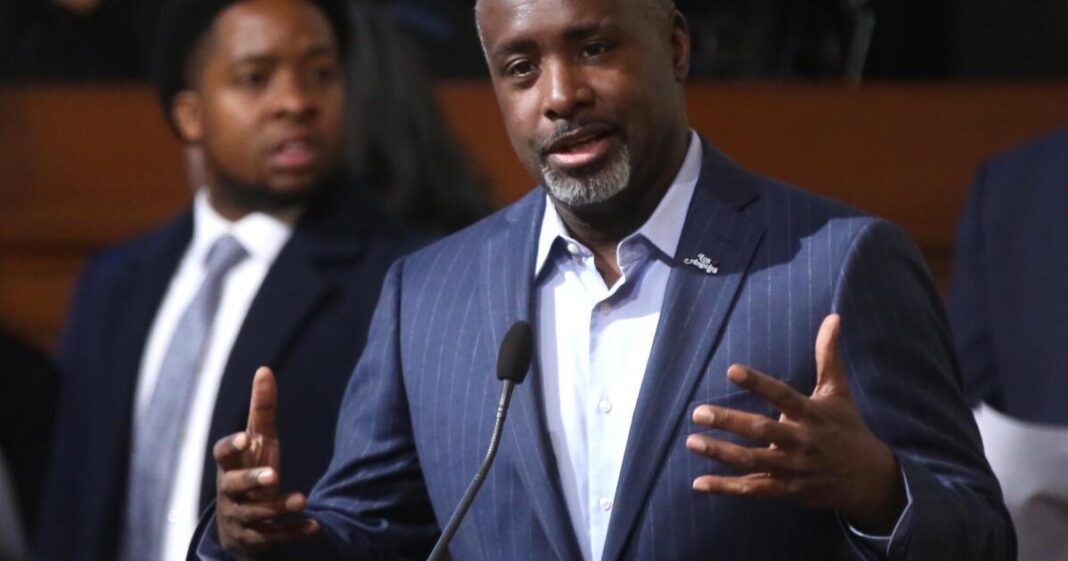
During a recent meeting focused on curbing specific police traffic stops, Council President Marqueece Harris-Dawson opened up about a recent unsettling experience. He shared that just two days prior, he had been pulled over by police — a reminder of the ongoing challenges many Black residents face in Los Angeles. Since taking office in 2015, Harris-Dawson has been stopped by law enforcement four times.
His recount of the latest stop drew immediate attention. Following his testimony, he candidly expressed, “It was as traumatic on Wednesday as it was when I was 16.” This personal narrative brought to light the broader systemic issues affecting communities of color.
The Incident Details
Interestingly, it wasn’t the Los Angeles Police Department (LAPD) that initiated the stop; it was an officer from the L.A. Unified School District police. Harris-Dawson was driving his Tesla Model Y on the freeway to work when he noticed an unmarked vehicle trailing him. Upon exiting the freeway, he was pulled over in a school zone. The officer approached his car with a hand on his gun — a scenario that heightened Harris-Dawson’s concern, as he initially feared he was encountering Immigration and Customs Enforcement.
The officer cited him for crossing a double-yellow line while preparing to turn left too early — a maneuver Harris-Dawson noted posed no risk to others. This incident stirred a conversation about the legitimacy and motivation behind such pretextual stops.
Responding to Claims
The aftermath of the stop saw the Los Angeles Police Protective League, which represents LAPD officers, jumping into action. Ricky Mendoza, the union’s president, called for an investigation into Harris-Dawson’s behavior during the incident. He suggested that the council president may have attempted to leverage his position to evade accountability for what they described as “reckless driving.”
Notably, allegations surfaced claiming Harris-Dawson had contacted a school board member during the stop in an attempt to mitigate the situation. However, four out of seven school board members stated they had no communication with him regarding the stop, muddying the waters of the unfolding narrative.
Navigating Racial Dynamics
The primary conversation surrounding this incident is rooted in race. Harris-Dawson’s experience reflects a broader issue of racial profiling and disproportionate scrutiny faced by individuals in Los Angeles, particularly among Black and Latino drivers. The police union’s statements and Harris-Dawson’s responses have only amplified these discussions.
“Harris-Dawson’s testimony implied LAPD pulled him over because of his race, not his driving behavior,” remarked Tom Saggau, a police union spokesperson. In contrast, community leaders, such as Councilmember Hugo Soto-Martínez, have voiced their support for Harris-Dawson, suggesting the union is attempting to silence crucial discourse on pretextual traffic stops that disproportionately affect marginalized communities.
Legislative Considerations
As tensions unfold, the City Council appears to be at a crossroads. With current discussions on limiting pretextual stops, Harris-Dawson’s recent encounter could either bolster reform efforts or serve as a flashpoint for political warfare among various city entities. The increasing scrutiny of police stops and the methods that enable profiling will be central to any legislative changes the council considers.
Cerrina Tayag-Rivera, a spokesperson for Harris-Dawson, criticized the police union for diverting attention away from important discussions, stating, “Just like pretextual traffic stops, the call for these pointless investigations violates the public trust.”
The Broader Impact
Ultimately, this incident encapsulates the intricate web of police relations and racial dynamics in Los Angeles. As community leaders rally around Harris-Dawson, the implications of the council’s decisions — whether to limit police stops or conduct further investigations — could serve as a precedent for policing reforms throughout the city.
This ongoing dialogue within City Hall serves as a critical lens into the challenges faced by communities in Los Angeles and represents a significant moment for both governance and social justice in the metropolis. Through engaged dialogue and legislative action, the city’s leadership may take decisive steps toward building trust and accountability in its policing practices.
Continue to follow us for updates on how this story and its implications develop!