
The Toothache That Uncovered a Crisis in Dental Care
I had a nagging toothache recently, leading to a revelation that was painful in more ways than one. It’s no secret that oral health care in the United States is in disarray, especially for seniors aged 65 and older. If you could X-ray this situation, you’d find a landscape peppered with cavities and neglected dental issues.
Elizabeth Mertz, a professor at UC San Francisco and a researcher with the Healthforce Center, encapsulated the issue perfectly. “It’s probably worse than you can even imagine,” she remarked, speaking about the barriers seniors face in obtaining adequate dental care. Mertz has referred to the current system, or rather its lack thereof, as a “mess,” highlighting the chaos that predominates in oral health care for older adults.
My Personal Dental Dilemma
But back to my toothache—I was desperate for relief. After two extractions in the previous two years, I approached my dentist with a mix of hope and dread. Sure enough, I was faced with another extraction due to a process called resorption; a bone graft and potential implant were recommended. The entire ordeal would span several months and cost about the same as a lavish vacation.
I consider myself fortunate to have a competent dentist and dental coverage through my employer, but let’s face it: dental insurance often feels inadequate. Sure, it covers routine cleanings and preventive care, but when it comes to more intricate procedures—especially those that accumulate with age—you could be left paying a hefty sum out of pocket. Many plans cap payouts around $1,500 annually, leaving patients like myself in a precarious financial situation.
The High Cost of Dental Care
Mertz points out that “the No. 1 reason for delayed dental care is out-of-pocket costs.” So, I found myself contemplating whether it would be more economical to switch to a Medicare Advantage plan that offers dental care benefits, although my two dentists strongly advised against this. Their concerns were valid: Medicare supplemental plans are riddled with limitations that can leave patients without adequate coverage.
Navigating this whole process can be tremendously confusing and time-consuming. Aging itself feels like a full-time job, yet the benefits are paltry. Most notably, essential specialty care—including dental, vision, hearing, and long-term care—remains mostly uncovered under basic Medicare. It almost appears as though Medicare was crafted by pranksters, and the consequences are becoming ever more apparent as the population aged 65 and older continues to grow.
The Dental Coverage Crisis Among Seniors
This brings up an urgent question: What are older adults supposed to do as their teeth start to falter? I spoke with a retired friend who, along with her husband, opted to forgo dental insurance altogether because it was too expensive and provided minimal coverage. Unfortunately, they are not an anomaly; estimates suggest that nearly half of U.S. residents aged 65 and older lack dental insurance entirely.
While cutting out insurance may seem like a reasonable choice given the premiums and caps, it poses a significant risk. Many individuals delay visiting the dentist until a crisis occurs, which can spiral into severe health consequences. As Paul Glassman, associate dean at the California Northstate University dentistry school, aptly said, “Dental problems are very clearly associated with diabetes, heart problems, and other health issues.”
Exploring Alternative Solutions
There is, however, an emerging solution: dental tourism. Mertz describes it as a growing trend where U.S. residents travel to countries like Mexico and Costa Rica for dental work. This approach offers not just treatment but also a vacation, often at a fraction of the cost associated with care in the United States. Tijuana-based dentist Dr. Oscar Ceballos shared that about 80% of his patients are Americans, some journeying from as far away as Florida and Wisconsin to benefit from lower costs and quality care.
In California, dental implants can cost anywhere from $3,000 to $5,000, while at Dr. Ceballos’s practice, the same service ranges from $1,500 to $2,500. These prices are largely due to lower overhead costs south of the border.
Patient Experiences: Quality Care Abroad
Speaking to patients has illuminated the benefits of dental tourism. For instance, John Lane from San Diego has been a regular patient of Dr. Ceballos for nearly a decade. He lauds the quality of care and asserts that it is “50% less than what it would be in the U.S.”, often saving even more than that.
As the summer approaches, Lane anticipates a surge of Californians visiting Mexican clinics. Proposed funding cuts to the Medi-Cal Dental program could have dire consequences for the state’s vulnerable residents. Robert Hanlon, president of the California Dental Association, expressed outrage over these potential cuts, stating that they could drive preventable dental emergencies into already crowded emergency rooms.
Community Commitment to Care
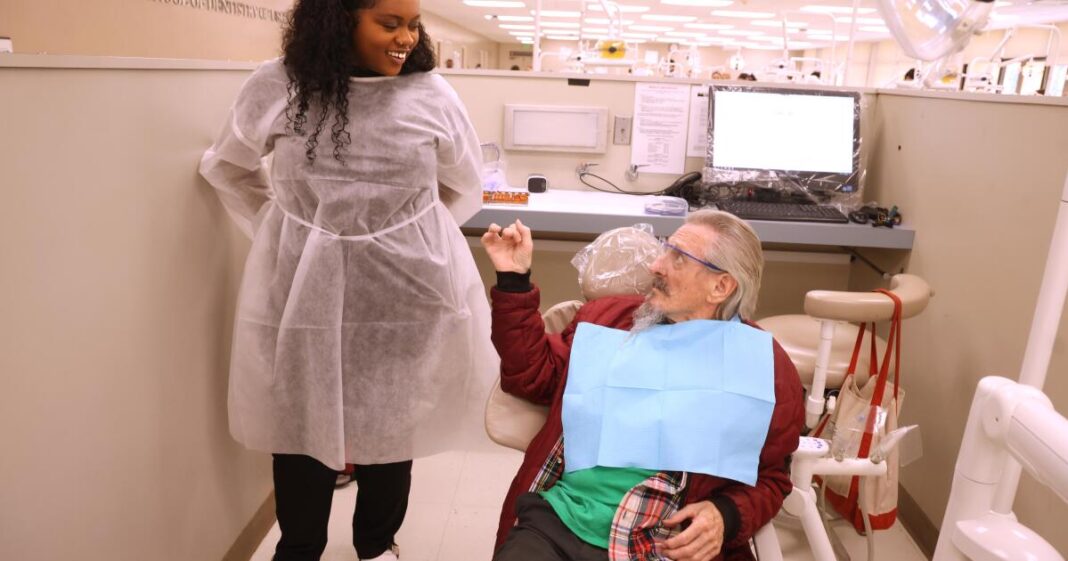
Many dental students, like Somkene Okwuego at the Ostrow School of Dentistry, are acutely aware of these disparities. Throughout her training, she’s primarily treated elderly patients lacking insurance, understanding firsthand the urgency of providing accessible care. Okwuego finds joy in “fixing the smiles” of her patients, believing it plays a crucial role in their self-esteem and job prospects.
Notably, the case of 83-year-old patient Jimmy Stewart highlights the importance of accessible care. After years without dental attention, he finally received high-quality treatment through the Ostrow clinic, all covered by Medi-Cal. If funding cuts proceed, he reflects, “I’d be screwed.” And indeed, he isn’t alone in this apprehension.
In a world of complex healthcare systems and mounting costs, the road to dental care can feel treacherous, particularly for our aging population. The urgency for reform is undeniable, and as we unveil the stories of those navigating these hurdles, it becomes clear that a collective approach is needed to ensure healthier smiles for all.