
The Rising Tide of Fear: A Citizen’s Response to Immigration Raids in Los Angeles
Unfolding a New Reality
Lawrence Herrera, a 67-year-old resident of Atwater Village, recently took the unusual step of carrying a folded copy of his birth certificate in his wallet. Alongside it, he saved a picture of his passport on his phone. For someone born and raised in Los Angeles, these acts might seem extreme, even silly. Yet, amid the backdrop of President Trump’s stringent immigration policies, Herrera isn’t leaving anything to chance. “I started hearing, ‘He’s taking anyone and everyone,’” he reflects, acknowledging the heightened fear and uncertainty surrounding immigration enforcement.
A July 4th Protest in Downtown Los Angeles
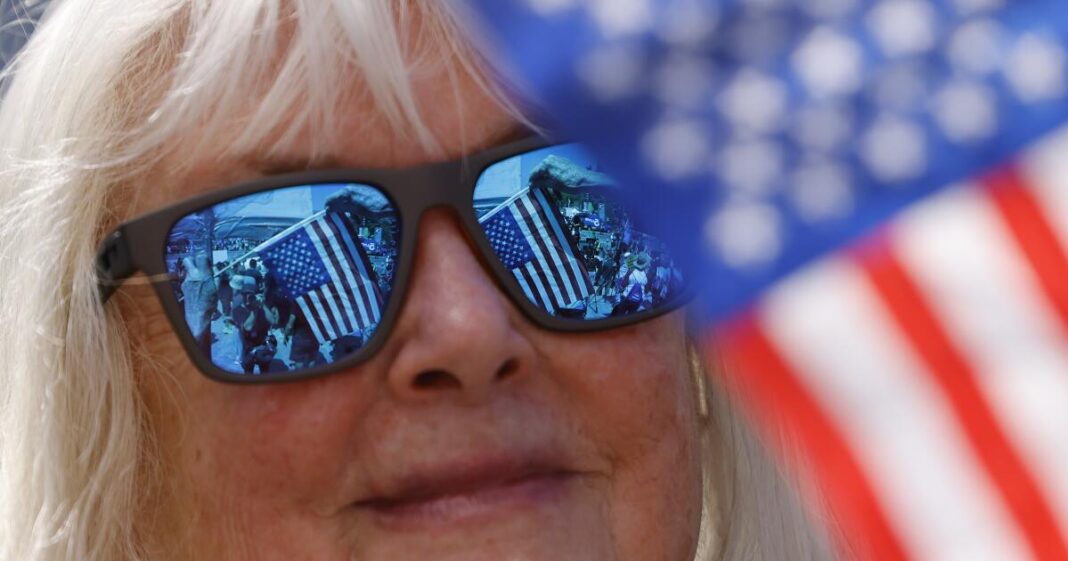
On the Fourth of July, as many prepared for barbecues and fireworks, Herrera joined hundreds of protesters in downtown Los Angeles, rallying against the recent immigration raids. This gathering was not just a demonstration of discontent; it represented a growing community response to federal policies seen as oppressive. With a 15-foot balloon of Trump adorned in a Russian military uniform looming over Grand Park, the atmosphere was charged with a mix of humor and indignation. People in costumes, like Erica Ortiz dressed as Lady Liberty in shackles, illustrated the sentiment, with Herrera donning a Revolutionary War outfit blanketed in anti-Trump pins. “Guess what? We have no independence right now,” he declared, embodying the frustration of a community feeling increasingly marginalized.
Chants of Dissent and Shared Concerns
As the marchers waved signs and chanted slogans like “No more occupation! No more deportation!” they made their way through Olvera Street and outside the federal building that houses the immigration court. The environmental and emotional stakes were palpable. Herrera’s concerns echoed the sentiments of many at the event, where safety and freedom felt like distant concepts. The evening concluded with a dispersal order from the LAPD, as tensions rose and officers confronted the crowd with “less lethal munitions,” highlighting the escalating conflict between citizens advocating for their rights and law enforcement.
The Impact of Immigration Raids
For many locals, these protests signify more than just political dissent; they are personal. Jacob Moreno, an English teacher from Rialto, poignantly described the day as a “funeral for the freedom we pretend” still exists. Many participants, like him, see these actions as a reflection of the broader implications on their communities—particularly when teachers worry about the well-being of their undocumented students and families. His daughter joined him in organizing support for affected families, demonstrating a tangible commitment to community resilience in the face of threat.
A Sense of URGENCY and Solidarity
Cristina Muñoz Brown of North Hollywood articulated a desperate need to make her presence felt: “I’m desperate for my people.” With nearby districts like the Fashion District feeling like “a ghost town” due to fears and ensuing raids, the protests highlight the broader economic and social repercussions on communities.
Political Landscape and Legislative Pushback
The political context surrounding these demonstrations is critical. Assemblymember Isaac Bryan condemned Trump’s budget bill, labeling it the “Big Beautiful Scam,” and highlighting that immigration spending eclipses military budgets for many countries. Such statements resonate with the crowd, as fears of more extensive raids become real. Federal strategies, including aggressive ICE raids targeting day laborers and the deployment of National Guard troops to maintain order, have only deepened the divide between local officials and the federal government.
A Call to Action
Mayor Karen Bass has continually urged Trump to cease the ICE raids, characterizing these actions as political theater rather than legitimate law enforcement. “They came for our neighbors in unmarked vans. Raided workplaces. Ripped apart families. Even U.S. citizens,” she lamented, articulating a collective distress shared by many protesters.
Ongoing Court Battles
The tense interactions between city officials and the Trump administration have led to ongoing legal battles over the deployment of National Guard troops and the legality of local sanctuary laws. Advocates for immigrant rights, including the ACLU of Southern California, have responded with legal actions against federal immigration policies, seeking to protect the rights of community members against systematic aggression.
These protests and the mounting tension reflect a profound fear and resistance within communities across Los Angeles. They signify not only a pushback against policies perceived as unjust but a broader movement towards solidarity, support, and advocacy for those who feel targeted and marginalized in their own homeland.